Promoted for your accomplishments.
Now measured by the team you lead.
The skills that earned the promotion are rarely the ones that make a team succeed. I coach executives and rising leaders as whole people, because a leader whose work and life are back in balance is more productive, happier and better able to lead. We work on thinking clearly under pressure, having the conversations that matter, and building teams that deliver even when they're not in the room. Below, you'll see exactly what you get as the sponsor, what stays private, and how we measure success.
Deciding whether to invest in one of your leaders? This page covers what you get, what stays private, and how you'll know it's working.

Most sponsors call when one of these shows up.
- You promoted your best individual contributor, and now the team is struggling.
- A strong leader has stalled at the same level, and you can see why even if they can't.
- Your leadership team agrees in the meeting and disagrees in the hallway.
- Someone you can't afford to lose has started looking around.
- A high performer is running on empty, and it's starting to show at work and at home.
- A new executive needs to land fast, and there's no room for a slow start.
- You're the one everyone brings problems to, and there's no one you can think out loud with.
Each of those gets more expensive the longer it runs. The discovery call is free, and you'll have a written proposal before you commit to anything.
For the leaders at the top, and the ones coming up.
Organizations get leaders who stay, grow, and make the people around them better.

Companies in a PricewaterhouseCoopers study for the International Coaching Federation reported an average return of about seven times what they invested in coaching.
ICF Global Coaching Client Study (2009). Results were reported by the client companies themselves.
What you'll hear, and what stays private.
Here's how it works, in writing, before we start. Anything shared with you, the leader either hears in the room or sees ahead of time. No surprises for anyone.
- Two to four goals agreed by you, the leader and me at kickoff
- Confirmation that sessions are happening as scheduled
- A three-way check-in at the midpoint to confirm progress and adjust course
- A three-way close that reviews results against the original goals
- What the leader says in sessions, and my coaching notes
- Individual 360 responses (peers and direct reports are reported only as group summaries)
- The 360 report and development plan belong to the leader, who decides what to share beyond the agreed progress updates
- Coaching is never used for discipline, ratings or employment decisions without the leader's written agreement
Clear goals at the start. Proof at the end.

- 1DiscoveryWe agree on the leader's goals and what success looks like for your organization.
- 2BaselineCliftonStrengths and/or 360 feedback set an honest starting point.
- 3CoachingRegular, confidential coaching sessions, with real practice on the job in between.
- 4ProgressSponsor check-ins at the midpoint and the close cover goals and results. What the leader shares stays private.
The Executive or Emerging Leader track. Twelve 50-minute sessions over six months is typical.
A few emerging leaders working on the same skills together, scoped with you.
A CliftonStrengths session for an intact team, so people see how each other is wired and stop losing time to friction.
One focused topic for a larger group, built from the leadership training catalog.
See trainingOne coach across the senior team and their direct reports, on a monthly retainer.
See the retainerIf you still have to sell this to a CEO, a CFO or a budget committee, I'll help. On the discovery call we'll build the case together, and I'll turn it into a one-page proposal you can forward: the leader's goals, how we'll measure progress, the cost, and the sponsor check-in plan.
I've sat where your leaders sit
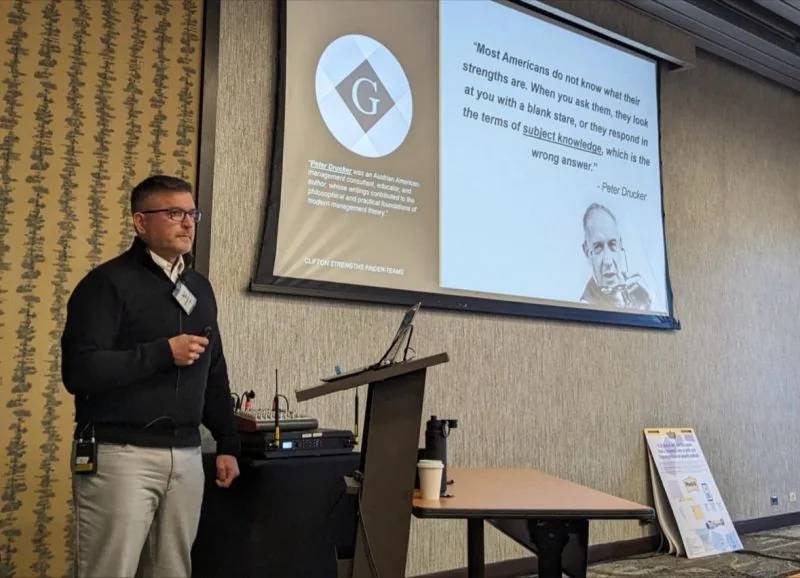
I didn't start out as a coach. I started out buying marketing leads online for a financial services company, with no background in finance at all. Over the years almost every department was rolled under me, and I ended up as Chief Operating Officer of a $200 million business.
Along the way I learned what every newly promoted leader learns, usually the hard way: the skills that earn the promotion are rarely the ones that make a team succeed. Nobody hands you that lesson with the new title.
The part of the job I loved was improving how teams work and developing people. Problem was, that was maybe 20% of my week. So I went back to school for a master's in Organizational Development, earned my ICF coaching credential, and it became a major part of my daily work.
Today I do organizational development and coaching for a large university medical campus in Colorado, and through Ascent I work with leaders and executive teams locally and around the country. Your leaders get a coach who has sat in the chair they're sitting in.

Allen L. Abbott
- ICF Associate Certified Coach (ACC)
- Gallup-Certified CliftonStrengths Coach
- 360 Feedback Certified Facilitator
- Crucial Conversations Certified Facilitator
- Executive MBA, UMKC Bloch School
- MS, Organizational Development, UT Dallas
Allen's coaching has been truly transformative. My productivity has grown by over 100%, and I've stepped into leadership roles that weren't even on the table before.
I've always been driven, but for years I was burning myself out chasing outcomes without asking if they were the ones I wanted. Allen helped me step back and aim that energy where it counts. I still push hard. Now I know where I'm pushing, and I'm not running on empty to get there.
Before you decide
What do you need from me as the sponsor?
Three meetings with the leader and me: a kickoff to agree on goals, a midpoint check-in, and a close that reviews results. Between those, you'll get a note confirming sessions are happening. The most useful thing you can do is back the goals and notice the change when you see it.
What does a coaching engagement cost?
There's no one-size price. Every engagement is scoped to the leader and the goals, and you'll get a written proposal after the discovery call. I can invoice your organization directly, provide a W-9, and split payments across budget periods.
How much of the leader's time does it take?
About one 50-minute session every two weeks, plus short sponsor check-ins.
How will we know it worked?
Against the goals we agree on at kickoff, reviewed at the midpoint and the close, plus the behavior change you can actually see on the job.
Can we coach a whole leadership team?
Yes. See Executive & Team Coaching.
What if the team is in active conflict?
Then coaching isn't the first step. Coaching works best from a reasonably healthy starting point. If conflict is hurting performance, we start with an Organizational Development engagement and get the team back on solid ground first.